

Table of Contents
- Why Banksy Artworks Define the Contemporary Art Market
- The Most Iconic Banksy Artworks and the Stories Behind Them
- Banksy Authentication Process: How to Verify a Work
- Banksy Prints for Sale: What Collectors Should Know
- The Legal and Ethical Battleground of Banksy Artworks
- Conservation and the Ephemeral Nature of Street Art
- Building a Collection: Where to Find and How to Buy
- Frequently Asked Questions
Last Updated: October 2, 2026
Why Banksy Artworks Define the Contemporary Art Market
Banksy artworks occupy a strange position: made anonymously, often illegally, and frequently destroyed by their own creator, yet traded at the highest levels of the auction market. This guide from The Art Howse covers how collectors verify, value, and acquire them without getting burned. The market prices Banksy like a blue-chip artist while the work itself remains deliberately unverifiable, unprotected, and impermanent.
That contradiction is why collectors need a process, not a hunch.
Banksy artworks are works of street art, stencil art, and limited-edition prints attributed to the anonymous British artist known as Banksy, whose practice spans public murals, canvas pieces, and signed print editions.
Three things drive the market:
- Scarcity of authenticated originals. Murals exist in public space; only prints and canvases are collectible.
- Narrative power. Each iconic work carries a story that fuels demand.
- Verification friction. Without official authentication, provenance does the heavy lifting.
Below: the most famous pieces, the authentication process, what to check before buying prints, and the legal fights that shape the market.
The Most Iconic Banksy Artworks and the Stories Behind Them
The most valuable Banksy artworks have a documented story: a public debut, a media moment, or a self-inflicted twist that turned the piece into an event. Narrative, not just image, sets the price.
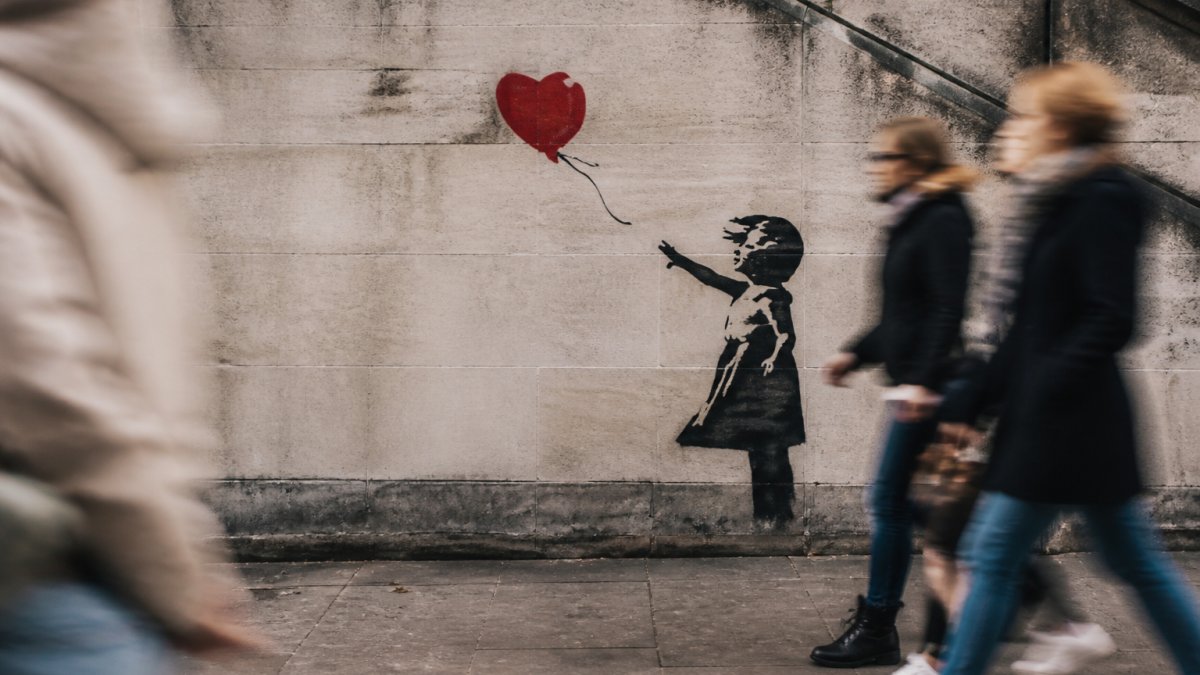
Two works dominate collector conversations.
Girl with Balloon: From Street Corner to Auction Record
Girl with Balloon began as a stencil on a London wall and became the artist's most reproduced image. A framed version sold at auction and then partially shredded through a hidden mechanism in the frame, instantly turning the piece into a new work.
The shredding was partial, not total, a detail that matters for authentication, insurance, and resale.
Love is in the Bin: The Self-Destructing Sensation
Love is in the Bin is the renamed, half-shredded version of that same lot, the clearest example of an ephemeral street-art gesture becoming a permanent collectible. It sets a precedent: documented disruption can increase value rather than destroy it.
Banksy Authentication Process: How to Verify a Work
The Banksy authentication process runs through Pest Control, the artist's own handling service. There is no external authority. If Pest Control does not confirm a work, treat it as unverified regardless of how convincing the image looks.
Verification typically involves:
- Photographic documentation of the piece, frame, and any signatures.
- Submission to Pest Control for review and, if accepted, a certificate.
- Provenance chain showing prior owners, galleries, or auction houses.
- Edition matching for prints, including numbering and any embossed marks.
Pest Control Office and Provenance Documentation
Pest Control issues certificates for works it accepts, and those certificates become the backbone of provenance. A certificate without a documented chain of ownership is weaker than one with a full history. For legal context on how authenticity claims are treated in commercial transactions, the Federal Trade Commission guidance on deceptive advertising is worth reading, since misrepresenting authenticity can cross into consumer-protection territory.
Banksy Prints for Sale: What Collectors Should Know
Banksy prints for sale fall into two tiers: officially released editions with Pest Control backing, and street-level reproductions with no documentation. The first is collectible; the second is decoration.
| Factor | Raises Value | Lowers Value |
|---|---|---|
| Authentication | Pest Control certificate | No certificate |
| Signature | Signed by artist | Unsigned or third-party signed |
| Edition | Low-numbered, limited run | Open or unclear run |
| Provenance | Documented auction history | No ownership record |
| Condition | Pristine, original frame | Restored or reframed |
Limited Editions, Signed vs Unsigned, and Price Drivers
Signed, low-numbered editions from a documented run carry the strongest resale case. Unsigned prints can still hold value if the edition is known and provenance is clean, but the buyer pool narrows. Condition, framing, and original paperwork all move the number.
The Legal and Ethical Battleground of Banksy Artworks
The legal status of Banksy artworks is unsettled by design, and that is the biggest reason collectors get hurt. Most of the work was created without permission on property the artist did not own, raising three questions buyers routinely conflate: who owns the physical wall, who owns the image, and who may reproduce it. The answers differ, and none are settled by the artist's fame.
Copyright: The Trademark Ruling That Changed the Calculus
For years the assumption was that the artist would not enforce copyright, so reproductions were treated as a gray zone.
For a buyer, the takeaway is that a print or object marketed as "official" or "authorized" needs a paper trail supporting the claim. If a seller leans on the artist's refusal to sue as proof of legitimacy, that is a warning sign, not a reassurance.
Ownership of Murals: When a Wall Becomes a Canvas and Then a Commodity
A mural painted on private property without permission collides the building owner's property rights with the artist's moral rights. When an owner removes a wall to sell the piece, ownership claims can collide and the buyer can end up with a clouded title, a common pattern is a mural cut from a wall, sold privately, then challenged by a party claiming an interest in the structure.
- Removal and sale of murals. The physical wall is real property; the image on it is a separate question. Get the removal authorization in writing.
- Unauthorized reproductions. Merchandise and prints using the imagery exist in a gray zone. Buyers paying a premium for "official" reproductions should demand the license or certificate that supports the label.
- Moral rights. Even where copyright is not enforced, moral-rights doctrines can affect how a work may be altered, attributed, or destroyed.
What This Means Before You Wire Funds
For collectors, a clean paper trail protects you more than a famous image does. Before committing capital:
- Ask who authorized the sale and get it in writing.
- Ask whether the image rights are included or whether you are buying only the physical object.
- Ask what happens if a claim surfaces later, who bears the loss, and under what terms.
- Treat any "the artist never sues" argument as a red flag, not a warranty.
For general context on how authenticity and origin claims are treated in commercial transactions, the Federal Trade Commission guidance on deceptive advertising is worth reading, since misrepresenting a work's origin or authorization can cross into consumer-protection territory.
Conservation and the Ephemeral Nature of Street Art
Conservation is the second gap most guides ignore, and where the market's contradictions become concrete. Street art is made for public space, exposed to weather, and often painted over; a mural that survives a decade is the exception. That fragility is part of the appeal and the risk, and it splits owners, institutions, and the artist's representatives on whether a work should be saved at all.
The Preservation Debate: Save It or Let It Decay?
Three positions dominate:
- Intervene. Conservators stabilize flaking paint, apply protective coatings, and in some cases remove and reinstall the work indoors. This preserves the object but changes its context, a mural moved inside is no longer street art in the sense that made it valuable.
- Document and let go. Preservation groups increasingly photograph, scan, and catalog works before they disappear, treating the record as the durable asset and the physical piece as inherently temporary. This supports long-term attribution even after the wall is gone.
- Allow decay. Some owners and critics argue that the ephemerality is the point, and that sealing a work under glass or coating it in acrylic betrays the form. This position is common among purists and is sometimes echoed by the artist's own camp.
For a collector, "condition" means something different for a mural-derived piece than for a canvas. A mural stabilized, cut out, and remounted has a conservation history that must be documented; one left in place has a projected lifespan that must be priced in.
What Actually Happens to Works on Paper and Canvas
If you own a canvas or print, standard fine-art care applies, but the specifics matter more than the generalities:
- Light. Ultraviolet exposure fades inks and yellows paper. Frame glass with UV filtering and keep works off direct sun. Rotate display rather than leaving a piece on a bright wall for years.
- Temperature and humidity. Fluctuation is more damaging than a stable non-ideal level. Aim for a stable environment and avoid attics, basements, and exterior walls.
- Handling. Oils from skin transfer to paper. Use gloves, support the sheet from below, and never handle a print by its edges over a hard surface.
- Framing. Original frames and mounting can be part of the value. Reversible mounting is preferred; irreversible dry-mounting can destroy resale value.
- Documentation. Keep the Pest Control certificate, edition paperwork, and any conservation reports together. A gap in the record is a discount at resale.
The Institutional Layer
Museums and preservation organizations are now active participants. Institutions acquire works to document and stabilize them, and preservation groups run documentation campaigns before pieces are painted over or demolished. This matters because institutional documentation can later serve as attribution evidence: a work in a reputable institutional record is easier to defend than one that exists only in a private photograph.
The American Institute for Conservation publishes guidance on caring for works on paper and canvas that applies directly here, and its find-a-conservator tool is the standard starting point for locating a qualified professional.
Building a Collection: Where to Find and How to Buy
Building a collection starts with verification, not acquisition.
- Decide what you are buying. A signed print, an unsigned edition, or a canvas each carry different risk.
- Request the full documentation set. Certificate, edition details, and ownership history.
- Verify through Pest Control before you commit funds.
- Check the provenance chain against auction records where possible.
- Confirm condition with an independent conservator for higher-value pieces.
- Set your exit before you buy. Know how you would resell and to whom.
An interactive map of works by city is useful for understanding where pieces exist publicly, but it does not substitute for documentation on anything you intend to purchase. Use maps for context, not proof.
Where does The Art Howse fit? As a fine art dealer and advisor working with Modern Masters and select established contemporary artists, we help collectors source specific works, assess provenance, and understand market positioning before committing capital. If you are new to collecting at this level, expect transparent discussion of fees and resale expectations before any acquisition.
Frequently Asked Questions
What is Banksy's most famous artwork?
Girl with Balloon is widely considered Banksy's most famous artwork. The stencil first appeared on a wall in London in 2002 and has been reproduced in various forms. In 2018, a framed version self-destructed during a Sotheby's auction, partially shredding and later being renamed Love is in the Bin. That event drew global attention and cemented the work's place in contemporary art history. Other notable pieces include Flower Thrower and Kissing Coppers.
How do you verify the authenticity of Banksy artworks?
The Banksy authentication process typically involves Pest Control, the artist's official authentication body. For street pieces, Pest Control issues a certificate of authenticity if the work is confirmed. For prints, check for a matching edition number, signature, and provenance from a reputable gallery or auction house. The Art Howse advises collectors to request full documentation and to consult with an advisor before purchasing any high-value work.
Why are Banksy artworks so valuable?
Banksy artworks are valuable due to a combination of scarcity, cultural impact, and market demand. His limited edition prints often sell for tens of thousands of dollars, while original canvases and installations can reach millions at auction. The anonymity of the artist adds intrigue, and his social commentary resonates with collectors. According to public auction results, works like Love is in the Bin have sold for over $25 million, reflecting strong market confidence.
Has Banksy ever done art in America?
Yes, Banksy has created several works in the United States. In 2013, he staged a month-long residency in New York City called Better Out Than In, which included street pieces, a delivery truck installation, and a pop-up booth selling canvases for $60. Other works have appeared in Los Angeles, San Francisco, and New Orleans. These pieces are part of the broader Banksy artworks catalog and are often documented in street art databases.
The hardest part of collecting Banksy artworks is not finding them. It is verifying them, pricing them, and knowing when to walk away. The Art Howse works with collectors to source specific works, review provenance documentation, and evaluate market positioning so you buy with confidence rather than hope. Get started with The Art Howse and build a collection you can actually defend.