

Table of Contents
- Beyond the Melting Clocks: Why Familiar Dalí Prints Only Tell Part of the Story
- How to Collect Salvador Dalí Art: Looking Past the Iconic Imagery
- Original Salvador Dalí Prints: Etchings, Drypoints, and Lithographs
- Salvador Dalí Lithographs and the Marx Brothers Story Behind Symphony Bicyclette
- Why Less Familiar Dalí Prints Reward a Collector's Attention
- How Context Enriches Looking Without Dictating Taste
- A Warm Invitation from The Art Howse
- Frequently Asked Questions
Last Updated: October 15, 2026
Beyond the Melting Clocks: Why Familiar Dalí Prints Only Tell Part of the Story
Ask someone to describe a Salvador Dalí painting and the melting clocks will almost certainly make an appearance. Perhaps the elephants on impossibly slender legs, or the burning giraffes.
But beyond these familiar images lies an extraordinary world of artistic invention, unexpected friendships, literary adventures, and cultural history.
For collectors willing to look a little further, Dalí's original graphic works offer something particularly rewarding: the opportunity to discover not only the artist's imagination, but the remarkable stories that helped shape it.
And sometimes, the story behind an artwork is every bit as fascinating as the image itself.
How to Collect Salvador Dalí Art: Looking Past the Iconic Imagery
Learning how to collect Salvador Dalí art begins with looking longer than the famous image allows. Dalí's graphic work spans decades and many moods: botanical suites, literary portfolios, Parisian street scenes, religious visions, and late theatrical fantasies. Ask what a print is doing rather than what it depicts.
Original Salvador Dalí Prints: Etchings, Drypoints, and Lithographs
Original Salvador Dalí prints are works the artist made as prints, not reproductions of paintings. An original print is created by the artist working directly on a plate or stone, or in close collaboration with a master printer, then pulled as a limited edition. A reproduction is a copy of an existing image made by someone else. Dalí worked across etching, drypoint, and lithograph, and across illustrated books and portfolios as well as single sheets.
Salvador Dalí Lithographs and the Marx Brothers Story Behind Symphony Bicyclette
Symphony Bicyclette is a magnificent color lithograph created in 1970, hand-signed and numbered from an edition of 200. The impression at The Art Howse is numbered 7/200.
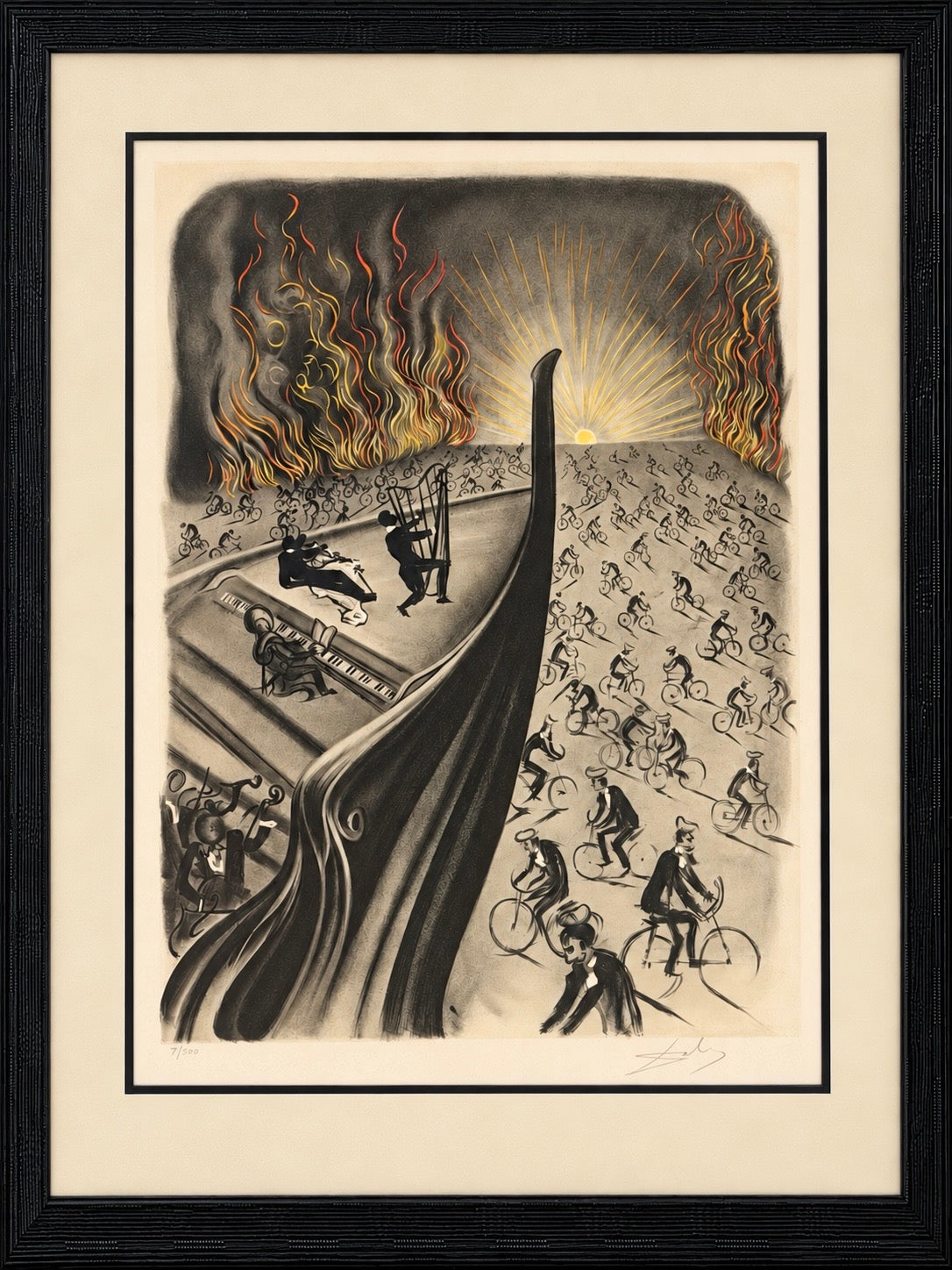
Salvador Dalí — Symphony Bicyclette (1970). Hand-signed color lithograph, numbered 7/200. Available at The Art Howse.
At first glance, the composition is quintessential Dalí: a fantastical procession of cyclists, musicians gathered aboard an improbable vessel, and a blazing horizon suggesting a world suspended somewhere between spectacle and catastrophe.
But look closer, and an unexpected chapter of twentieth-century cultural history begins to emerge.
Dalí developed a remarkable friendship with Harpo Marx, the famously silent member of the Marx Brothers. Their shared affection for absurdity and visual comedy inspired plans for a Surrealist film titled Giraffes on Horseback Salad, which was never produced. The Dalí Museum's exhibition on Dalí and Harpo Marx explores this extraordinary friendship.
Decades later, Symphony Bicyclette celebrated that friendship through Dalí's unmistakable visual language. The harpist within the composition offers a particularly delightful reference to Harpo himself. John Moran Auctioneers describes the 1970 lithograph as a tribute to Harpo Marx.
The earlier 1937 Marx Brothers film-project drawing and this 1970 lithograph are separate works, with distinct dates, media, and edition histories. The friendship and shared imagery connect their stories; they do not make the two objects interchangeable.
The lithograph is a wonderful reminder that Surrealism was never confined to painting. Its influence extended into cinema, literature, comedy, and the wider cultural imagination. Here, Dalí brings those worlds together in a single extraordinary image.
Discover Symphony Bicyclette at The Art Howse →
Why Less Familiar Dalí Prints Reward a Collector's Attention
Symphony Bicyclette makes the case for looking beyond the iconic imagery better than any argument could. It is unmistakably Dalí, the blazing sky, the dreamlike scale, the wit, with a story no melting clock can tell. The same is true across the graphic work: Flora Dalinae turns botanical precision into something almost otherworldly, Alice in Wonderland transforms Carroll's narrative into a dreamlike visual language, and Place Furstenberg captures a quiet Parisian square with drypoint precision.
Salvador Dalí — Flora Dalinae: Passion Flower →

Work |
Medium |
What It Rewards |
|---|---|---|
Flora Dalinae: Passion Flower |
Etching in colors on Arches paper |
Botanical symbolism and color |
Place Furstenberg (1971) |
Drypoint with stencil coloring |
Intimate Parisian atmosphere |
Symphony Bicyclette (1970) |
Color lithograph |
Cinematic and personal history |
How Context Enriches Looking Without Dictating Taste
Understanding the history behind an artwork doesn't determine whether we should love it. That remains an entirely personal decision.
But context can deepen our appreciation.
A beautiful image may initially attract us through its composition, color, or emotional resonance. Discovering the artist's inspiration, the circumstances of its creation, or its connections to a larger cultural story can transform that initial attraction into a lasting relationship.
This is one of the great pleasures of collecting original prints. Each work has its own history, and sometimes the less familiar images have the most extraordinary stories to tell.
At The Art Howse, we believe that knowledge should enrich the experience of collecting, never complicate it unnecessarily.
Ultimately, the most important response to a work of art remains your own.
A Warm Invitation from The Art Howse
Dalí's familiar images will always be the front door. What you find past it depends on how far you are willing to walk.
If you would like to see Symphony Bicyclette or any of the works discussed here in more detail, we are glad to talk it through with you. We share what we know about each work, including its medium, its edition, and the history behind it, and we will tell you honestly when a detail remains unresolved. Your taste leads.
The Dalí Museum's exhibition on Dalí and Harpo Marx is worth exploring if the story here has caught your attention.
Frequently Asked Questions
What should collectors look for in a Salvador Dalí print?
Start with the work itself: does the imagery hold your attention beyond the famous motifs? Then look at the medium and how it was made. An original etching, drypoint, engraving, or lithograph is a different object from a reproduction, and the distinction matters. Edition information, a pencil signature, and any documented reference to the artist's graphic catalogue all help build a fuller picture, but each piece of evidence should be weighed on its own terms rather than treated as proof by itself.
What is the difference between an original Salvador Dalí print and a reproduction?
An original Salvador Dalí print is pulled from a plate, stone, or other matrix the artist was involved in creating, and it belongs to a stated edition. A reproduction copies an existing image photographically and has no place in the artist's graphic oeuvre. The distinction is not about price or size. It comes down to how the image was made and whether the impression sits within the edition the artist authorized and signed.
Does a signature or edition number prove that a Dalí print is authentic?
No. A pencil signature and an edition number are useful evidence, not proof on their own. Legitimate editions can be unsigned or unnumbered, and signatures have been added to prints after the fact. The stronger picture comes from combining what the sheet itself shows with the medium, the paper, and any reference to the artist's catalogued graphic work. Weigh the evidence appropriate to that particular print rather than applying one universal checklist.
The most rewarding collections are rarely built from the most recognizable names alone. They are built from works whose stories stay with you, and from relationships with people who take those stories seriously. If you are ready to look past the melting clocks, we would be glad to help you find the Dalí that belongs in your collection. Reach out to The Art Howse and we will walk you through the work, the edition, and the history, one piece at a time.