

Table of Contents
- Why Fine Art Investment Opportunities Belong in a Diversified Portfolio
- Art Portfolio Diversification Strategies for Serious Collectors
- How to Start an Art Collection for Investment
- Valuation, Provenance, and Liquidity: What Drives Fine Art Prices
- Tax Implications of Art Investment for U.S. Collectors
- Best Practices for Art Storage and Insurance
- Exit Strategy and the Regulatory Landscape for Fine Art Investment
- Conclusion: Matching Fine Art Investment Opportunities to Your Goals
- Frequently Asked Questions
Last Updated: October 4, 2026
Why Fine Art Investment Opportunities Belong in a Diversified Portfolio
Fine art investment opportunities have moved from the margins of wealth management into the mainstream, and for good reason. At The Art Howse, we work with collectors who treat art as a genuine asset class.
Art investment means acquiring works with careful attention to quality, authenticity, price, and long-term market prospects. At The Art Howse, we believe the starting point is a work you want to live with. Preservation and potential appreciation of capital can inform the decision, but neither is guaranteed. The collector also enjoys something a financial account cannot provide: the daily experience of living with art.
Most portfolios are concentrated. A typical high-net-worth allocation leans heavily on public equities and fixed income, both of which react to the same interest rate signals. Art responds to different forces: scarcity, provenance, and collector demand. That is the diversification case in one sentence.
How Art Performs Against Stocks and Bonds
Art behaves differently from securities in three ways that matter to a portfolio: it is scarce, it is illiquid, and its price discovery is private.
A stock can be issued again, split, or diluted. A signed Matisse lithograph from an edition of 75 cannot. That fixed supply is the foundation of long-term value, but it cuts both ways.
Illiquidity is a real commitment: a sale can take time, and the price achieved may differ substantially from an appraisal. Art markets respond to collector demand and broader economic conditions, so diversification benefits should never be assumed.
The practical takeaway: art belongs in the portion of your portfolio you will not touch for five to ten years.
Art Portfolio Diversification Strategies for Serious Collectors
Diversification in art does not mean buying many cheap works. It means spreading exposure across artists, movements, mediums, and price tiers so that no single market shift sinks your collection.
We group collector portfolios into three tiers:
- Blue-chip foundation: Established masters with deep auction records and global demand. These offer more market evidence, but resale and value retention remain uncertain.
- Established artists: Artists with museum representation and a decade-plus of secondary market activity. Market depth and resale prospects vary considerably by artist and work.
- Emerging allocation: Smaller positions in artists early in their arc. This is the speculative slice, and it should stay small.
The ratio depends on your goals. A collector prioritizing capital preservation might weight heavily toward the foundation tier. Someone chasing capital appreciation accepts more volatility in exchange for upside.

Balancing Blue-Chip Masters With Emerging Contemporary Work
Established masters have deeper sales records and broader collector recognition, which can make market comparisons easier. Their prices can still fall, and authenticity, provenance, and condition must be assessed for each work. A famous name alone does not ensure a sound acquisition.
Emerging contemporary work offers the opposite profile. Entry costs are lower, and the upside can be substantial if an artist's market matures. The risk is real: many emerging markets stall, and liquidity can evaporate.
Our approach is to combine careful research into established artists with a measured commitment to contemporary work that resonates with the collector. Keep speculative purchases within an amount you could comfortably afford to lose.
How to Start an Art Collection for Investment
Starting a collection for investment purposes begins with a budget, a thesis, and a due diligence process, in that order. Buyers who skip straight to browsing usually overpay for works that do not fit any coherent strategy.
Set a total allocation first. Then decide which tier it serves. Only then should you look at specific works.
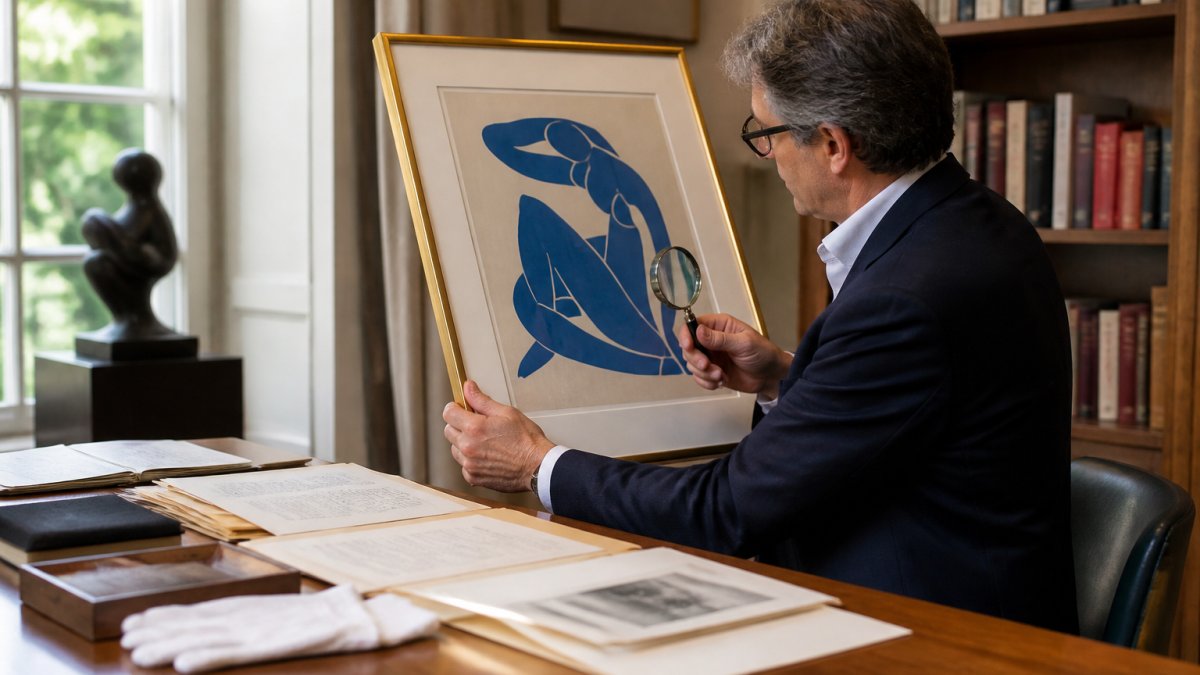
Working with an advisor shortens the learning curve considerably. An advisor sources works, verifies provenance, and provides guidance.
Building a Due Diligence Checklist Before You Buy
Run every acquisition through the same checklist. Thorough research may require specialist advice and time, but it can reduce the risk of expensive errors.
- Assess authenticity: Check catalogue references, edition details, and available documentation. Genuine works may be unsigned, signed in the plate, or portfolio-signed.
- Review available provenance: Note known ownership history, such as private-collection or auction records, and disclose gaps. Complete provenance is not always available.
- Check the edition: size, whether it is numbered, and how many impressions exist
- Review condition: any restoration, foxing, or framing damage
- Compare recent comparable sales for the same artist and medium
- Confirm the work is not subject to any lien or ownership dispute
- Get the total cost in writing: price, buyer's premium if any, shipping, and insurance
That last item matters more than most buyers expect. The headline price is rarely the full cost.
Valuation, Provenance, and Liquidity: What Drives Fine Art Prices
Three factors drive fine art prices more than anything else: provenance, condition, and liquidity. Get any one of them wrong and the others cannot rescue the value.
Provenance is the documented chain of ownership for a work.
Take the Warhol Campbell Soup 1: Black Bean Soup screenprint in our collection.

Condition affects value directly. A print with faded colors or trimmed margins is worth materially less than a pristine example from the same edition, even when both are authentic.
Liquidity is the wildcard. Auction records for established names provide useful comparisons, but a particular work may take time to sell or fail to find a buyer.
Salvador Dali - Alice- Alice in Wonderland portfolio Frontispiece, 1969 →
Valuation itself combines auction comparables, gallery pricing, and condition assessment. Appraisals depend on their purpose and effective date; an insurance valuation may differ from fair market value or the net proceeds of a sale.
Tax Implications of Art Investment for U.S. Collectors
The tax treatment of art depends on how you hold it and how you sell it, and the rules are not intuitive. This is where collectors most often get surprised.
If you buy art purely as an investment and sell at a gain, the profit is generally treated as a capital gain, but collectibles are subject to a higher maximum rate than ordinary long-term capital gains (Topic no. 409, Capital gains and losses).
If you donate a work to a qualified charitable organization, the deduction rules differ depending on whether the recipient will use the work for a purpose related to its exempt function or simply sell it.
Estate planning adds another layer. Art held until death may receive a step-up in basis, which can eliminate a lifetime of accrued gain for your heirs.
These rules are complex, and the details change. Consult a tax professional who handles collectibles before you buy, not after you sell. The IRS guidance on charitable contributions of property is the place to start understanding the deduction rules.
Best Practices for Art Storage and Insurance
Proper storage and insurance protect both the work and the investment. Damage or theft can cause a substantial financial loss, making appropriate coverage essential.
Storage conditions should be stable. Works on paper are sensitive to light, humidity, and temperature swings. Ultraviolet-filtering glass or acrylic, controlled humidity, and consistent temperature prevent the slow degradation that quietly erodes value.
Insurance should be scheduled, not general. Standard homeowners policies cap fine art coverage at levels far below what a serious collection requires. Scheduling identifies individual works and their insured values. Ask whether coverage is on an agreed-value basis and review exclusions, deductibles, transit coverage, and claim terms.
Keep documentation current. Photograph each work, retain every receipt and certificate, and update valuations periodically. Insurers and buyers alike will ask for this record.
Exit Strategy and the Regulatory Landscape for Fine Art Investment
Every acquisition should come with an exit plan before you buy it. Collectors who never think about selling are the ones who panic when they need to.
Your exit options fall into three broad paths: public auction, private sale, and dealer buyback. Each has a different timeline, cost, and price outcome. Auction offers transparency and competitive bidding but carries seller's commissions and the risk of a bad result on a given day.
Exit Route |
Typical Timeline |
Cost Consideration |
Best For |
|---|---|---|---|
Public auction |
Weeks to months |
Seller's commission applies |
Blue-chip works with broad demand |
Private sale |
Months |
Negotiated, often lower |
Discreet, high-value transfers |
Dealer buyback |
Days to weeks |
Lowest net price |
Urgent liquidity needs |
Collectors should consider lawful ownership, cultural-property restrictions, import requirements, and sanctions when buying or moving art across borders. Anti-money-laundering requirements vary by jurisdiction and business activity; rules for banks, antiquities dealers, and fine-art dealers should not be treated as interchangeable. Document the transaction and seek qualified advice when questions arise.
Conclusion: Matching Fine Art Investment Opportunities to Your Goals
The right fine art investment opportunities depend entirely on your horizon, your liquidity needs, and your tolerance for a market that moves slowly. There is no universal allocation, and anyone who claims otherwise is selling something.
That is where working with a specialist helps. The Art Howse sources works by the Modern Masters and select established contemporary artists, with documented provenance and transparent pricing. We offer museum-quality pieces like a hand-signed Henri Matisse lithograph from an edition of 75, and blue-chip Pop Art such as a signed Andy Warhol Campbell Soup 1 screenprint with provenance tracing to the early 1980s.

Get started with The Art Howse and build a collection that reflects both your taste and your financial goals.
Frequently Asked Questions
Is fine art a good investment for diversifying a portfolio?
Fine art can form part of a broader collection and financial strategy, but its diversification benefits are uncertain and vary by artist, work, and market conditions. Scarcity alone does not ensure demand or appreciation. Account for illiquidity, insurance, care, and buying and selling costs, and commit only funds you can leave untouched for years. The pleasure of owning the work should remain central.
How much money do I need to start an art collection for investment?
Collectors can begin with original graphics in the low four figures, but distinguish carefully between hand-signed editions, unsigned impressions, and signatures printed in the plate. A lower-priced Chagall exhibition lithograph is a different proposition from a hand-signed, numbered work. Compare the specific edition, condition, documentation, and current asking price rather than relying on the artist name alone. Starting with a focused category you understand helps you buy intelligently.
What are the primary risks associated with fine art investment?
The main risks are illiquidity, authenticity disputes, condition issues, and market volatility within specific artist segments. Provenance gaps can stall a resale, and fakes exist even at high price points. Storage and insurance add ongoing costs. A due diligence checklist covering provenance documentation, condition reports, and edition verification reduces much of this risk before you commit capital to any single work.
How do modern masters compare to contemporary artists in terms of ROI?
Modern Masters have substantial auction histories and established collector recognition, which provide useful evidence for evaluating an acquisition. They can still lose value. Contemporary markets vary widely, and emerging artists may carry greater uncertainty. No artist category offers a dependable rate of return; purchase price, authenticity, condition, demand, holding period, and selling costs all affect the outcome.
What is the 70/30 rule in art investing?
A 70/30 split is an illustrative way to divide an art budget between established and more speculative purchases, not a recognized standard or a guarantee of lower risk. There is no universal allocation. Your budget, taste, liquidity needs, and ability to tolerate losses should determine the balance.
What tax implications should I know before investing in art?
In the U.S., net long-term gains on collectibles such as art are subject to a maximum federal rate of 28%. Short-term gains generally follow ordinary income rates; additional federal and state taxes may apply. Section 1031 like-kind exchange treatment generally does not apply to artwork. Charitable deductions depend on the circumstances and documentation. Sales or use tax may also apply at purchase. Consult a qualified tax professional before buying, donating, or selling.
How should I store and insure a fine art collection?
Keep works away from direct sunlight, damp conditions, and rapid temperature or humidity changes. Seek a conservator's advice for the particular medium and use appropriate UV-filtering glazing for works on paper. Ask an insurer about scheduled or specialist fine-art coverage, including valuation basis, transit, exclusions, and deductibles. Update documentation and valuations as the policy requires.