

Table of Contents
- Define Your Personal Taste and Collection Vision
- Set Your Art Collection Budget and Understand Costs
- Art Collecting for Beginners: Research and Authentication
- How to Buy Original Art and Limited Editions
- Document and Organize Your Art Collection Inventory
- Protect Your Investment: Authenticity, Provenance, and Insurance
- Display, Care, and Preserve Your Artwork
- Start Your Collection Today
- Frequently Asked Questions
Last Updated: October 9, 2026
Define Your Personal Taste and Collection Vision
Learning how to start a private art collection begins with understanding what moves you.
Ask yourself what draws you to art: abstract or representational? Contemporary artists or established Modern Masters?
Many collectors chase trends or buy for appreciation, ending up with a disjointed warehouse rather than a curated vision.
Visit galleries, museums, and art fairs without pressure to purchase.
Set Your Art Collection Budget and Understand Costs
Establish a realistic budget before you buy anything. Acquiring artwork involves more than the purchase price: framing, insurance, conservation, and authentication fees all add up.
Determine how much you can comfortably invest over time. Many serious collectors acquire one or two pieces per year, developing their eye gradually and avoiding costly mistakes.
Consider these cost categories:
- Purchase price, the artwork itself
- Framing and display, professional framing can range from modest to substantial
- Insurance, essential for protecting valuable pieces
- Authentication and appraisal, may be required for certain works
The Art Howse specializes in original works by Modern Masters and contemporary artists, with pieces starting at accessible price points. For example, a Marc Chagall lithograph from 1968 is available at a thoughtfully priced entry point, while significant works like Andy Warhol's Campbell Soup screenprints represent higher-value acquisitions for experienced collectors.

Art Collecting for Beginners: Research and Authentication
Before any purchase, research the artwork, the artist, and the market.
Research the artist's background: museum exhibitions, career trajectory, gallery representation. Documented exhibition histories and critical recognition distinguish emerging talent from speculative work.
Learn about the piece: provenance (documented ownership history), certificate of authenticity, condition, and restoration issues, all affect value and enjoyment.
For prints and multiples, know the edition size and whether the work is numbered.
How to Buy Original Art and Limited Editions
Knowing where and how to acquire artwork is crucial to building strategically.
Evaluating Artists and Artworks
Consider the artist's market position and trajectory. Established artists with consistent exhibition history and institutional recognition typically preserve value more stably than unknown emerging artists.
Assess condition carefully, even minor restoration affects value. Ask about repairs or conservation work, and for prints, verify edition number and total size; lower numbers often command slight premiums.
Examine the medium and technique. Original works, etchings, lithographs, paintings, typically appreciate differently than mass-produced reproductions.
Galleries, Art Fairs, and Direct Sources
Galleries remain the primary source for authenticated artwork. Established galleries curate inventory, handle authentication, provide expertise, and typically guarantee authenticity with recourse if issues arise.
The Art Howse operates as a fine art dealer and advisor, offering works by Modern Masters and established contemporary artists.
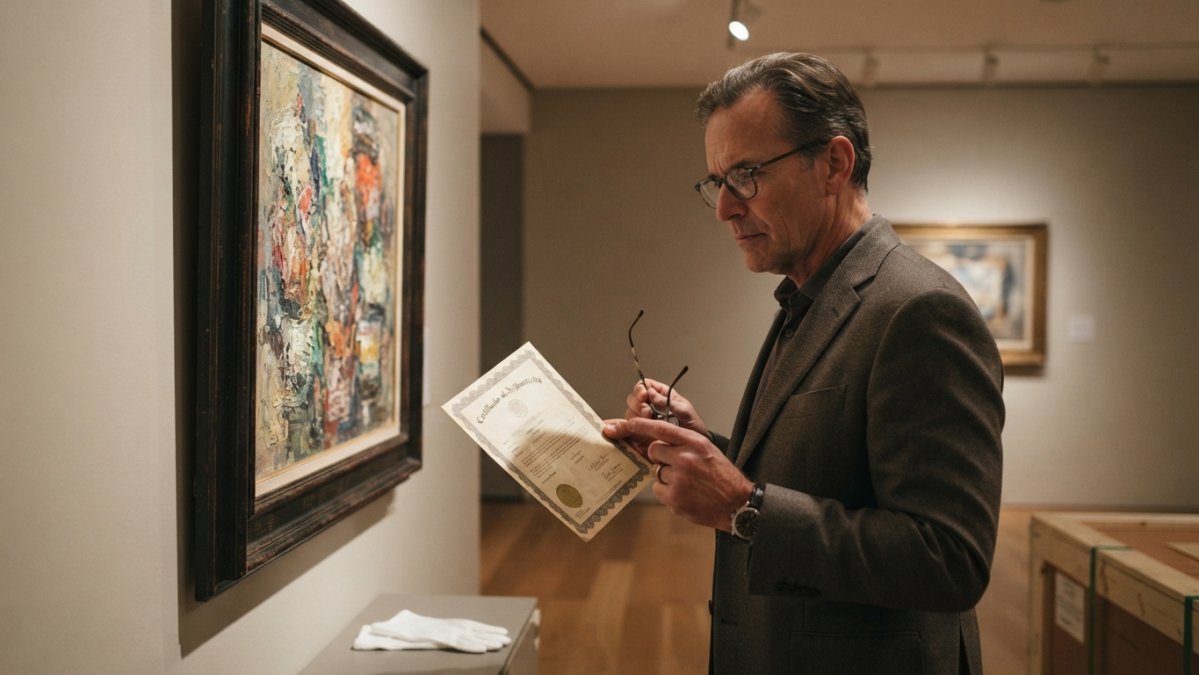
Collector examining a framed artwork under soft gallery lighting, holding a certificate of authenticity document and studying details closely
Document and Organize Your Art Collection Inventory
Documentation is the least glamorous part of collecting and the one that saves the most money and grief. A complete record protects your investment, speeds insurance claims, simplifies estate planning, and eases future sales. Treat the inventory as a living system.
What to Record for Every Work
Create a detailed record for each piece, and keep it consistent across the collection:
- Artist name, nationality, and biographical dates
- Title, date, and any alternate titles
- Medium and support (for example, oil on canvas, lithograph on paper)
- Dimensions, in both inches and centimeters, and whether they include the frame
Photographs and Digital Files
Photograph each work under consistent lighting, capturing front, back, signature, edition number, and labels. Name files consistently, artist, title, year, sequence, and store originals in at least two places: a cloud backup and a separate offline drive.
Condition Reporting and Valuation Cadence
Record condition at acquisition and re-check on a schedule, noting changes, frame damage, foxing, surface shifts, with the date observed. A dated log is far more persuasive in an insurance claim than memory.
Update appraisals every three to five years, and after any major market shift or significant acquisition. Note the appraisal date next to the insured value so you can see which pieces are overdue for review.
Receipts, Certificates, and Provenance Files
Keep receipts, invoices, certificates of authenticity, condition reports, and provenance documents with the piece's record, not scattered across email and filing cabinets. These establish the chain of custody that protects value and are what an insurer, appraiser, or buyer asks for first. Scan paper documents and store digital copies alongside the photographs.
Administration, Lending, and Succession
Documentation also underpins later ownership stages. If you lend a work, record the loan agreement, borrowing institution, dates, and the borrower's insurance. If you gift a work, keep transfer documentation and any qualified appraisal for tax purposes.
Salvador Dali - Alice- Alice in Wonderland portfolio Frontispiece, 1969 →
For succession, your inventory becomes the roadmap. An estate plan should identify which works pass to heirs, which may be donated, and how value is documented for estate tax purposes.
Estate and gift tax guidance for collectors
Protect Your Investment: Authenticity, Provenance, and Insurance
Protecting a collection is an ownership discipline, not a one-time purchase. It rests on four pillars: verified authenticity, documented provenance, accurate valuation, and insurance that responds when something goes wrong.
Authenticity and Provenance Due Diligence
Authenticity verification begins before you pay. Reputable dealers and auction houses provide a certificate of authenticity backed by their expertise. For significant acquisitions, independent authentication by a recognized expert may be warranted, it costs money upfront but prevents catastrophic loss later.
Provenance, the documented ownership history, affects both value and your legal confidence in ownership. A clear chain of custody shows the work is what it claims to be and that no competing claims attach.
Before purchase, ask a consistent set of questions:
- Is there a written certificate of authenticity, and who issues it?
- What is the full provenance, with dates and prior owners where available?
- Is there a condition report, and who prepared it?
- What is the return policy, and how many days does it allow?
Appraisals and Valuation
Insurance is only as good as the number attached to it. Have significant pieces appraised by a qualified appraiser, the IRS expects a qualified appraisal for charitable donations, and insurers expect a defensible value.
Distinguish replacement cost from market value. Insurers generally settle on replacement cost, what it would take to buy a comparable work today, while market value reflects what the piece would fetch in a sale.
Insurance Coverage Mechanics
Standard homeowner's or renter's policies typically exclude fine art or cap coverage far below the value of a serious collection. Specialized fine art policies fill that gap. When comparing coverage, focus on:
- Scheduled vs. blanket coverage. Scheduled policies list each work with an agreed value; blanket coverage insures the collection up to a total limit. Scheduled coverage is cleaner for high-value pieces.
- Agreed value vs. actual cash value. Agreed value pays the amount listed without a depreciation argument. Actual cash value pays less.
- All-risk vs. named-peril. All-risk covers more causes of loss, subject to exclusions; named-peril covers only listed events.
- Deductibles. A higher deductible lowers premium but shifts more risk to you.
- Transit and off-premises coverage. Confirm the policy covers works in transit, on loan, in storage, and at exhibitions, not just at home.
Work with an insurer or broker experienced in fine art; they understand replacement cost differs from market value and can structure coverage accordingly.
Transit, Storage, and Risk Management
Most losses happen during movement, not while a work hangs on the wall. Use a fine art shipper, not a general courier, and confirm door-to-door insurance.
For storage, climate control is non-negotiable: fluctuating temperature and humidity damage paintings, prints, and frames. Avoid basements, attics, and unconditioned units. Keep works off the floor and away from exterior walls, at the same temperature and humidity ranges as a display space.
Fine art insurance and appraisal guidance
Display, Care, and Preserve Your Artwork
How you display and maintain your collection affects its longevity and your enjoyment.
Avoid direct sunlight, which fades colors and degrades paper and canvas.
Handle with care: oils from bare hands transfer to surfaces and cause permanent damage.
Maintain stable temperature between 65-75 degrees Fahrenheit and relative humidity between 45-55 percent to prevent warping, cracking, and deterioration.
Start Your Collection Today
Building a private art collection combines aesthetic enjoyment with thoughtful acquisition strategy.
The Art Howse offers curated works by Modern Masters and established contemporary artists, providing authenticated pieces with documented provenance and expert guidance.
Begin where you are. Visit galleries. Study artwork. Let your genuine aesthetic preferences guide your decisions. A thoughtfully built collection becomes not just an investment, but a reflection of who you are and what moves you.
Frequently Asked Questions
How much money do you need to start an art collection?
There is no minimum. You can start a private art collection with any budget. Original artworks range from under $1,000 to six figures or more. Limited edition prints and lithographs by Modern Masters often cost between $1,000 and $5,000, making them accessible entry points. The key is defining your budget first, then researching artists and works within that range. Many collectors begin modestly with affordable pieces and expand over time as their confidence and resources grow.
How do you choose your first piece of art for a collection?
Start by identifying what genuinely interests you—don't buy based on investment potential alone. Spend time viewing artwork at galleries, exhibitions, and online platforms to discover styles and artists that resonate with your taste. Research the artist's background, provenance of specific works, and condition. For your first purchase, consider a piece that excites you emotionally and fits within your budget. Original art and limited editions by established artists provide both authenticity and a clear investment foundation for building your collection.
What is provenance and why does it matter when buying original art?
Provenance is the documented history of ownership and location of an artwork. It proves authenticity and protects your investment by showing the piece has been properly cared for and legally acquired. When buying original art, always request complete provenance documentation, including certificates of authenticity, exhibition records, and ownership history. Strong provenance increases an artwork's value and makes it easier to sell or insure later. Works with gaps in provenance or unclear ownership history carry higher risk and should be approached with caution.
How do I know if an artwork is authentic before buying?
Request a certificate of authenticity from the seller or dealer. For original prints and limited editions, verify the edition number, signature, and printing details match the artist's records. Research the artist's catalog raisonné (complete listing of works) if available. Buy from reputable galleries and dealers who specialize in the artist's work and stand behind their authenticity claims. Ask about provenance documentation and condition reports. For significant purchases, consider having an independent art appraiser or conservator examine the piece. Established fine art dealers maintain relationships with authentication experts and can provide detailed documentation of authenticity.
Building a private art collection requires confidence in your choices and trust in your sources. The Art Howse provides authenticated works by Modern Masters with complete provenance documentation, expert authentication, and professional guidance through every acquisition. Start with pieces that genuinely speak to you, and let your collection grow organically over time.