

Table of Contents
- Original Marc Chagall Prints vs Reproductions: What Sets Them Apart
- How to Authenticate a Marc Chagall Print
- Marc Chagall Lithographs: The Gold Standard of His Printed Work
- Marc Chagall Reproductions: Understanding Authorized Editions
- Marc Chagall Print Value: Pricing, Condition, and Market Factors
- Available Marc Chagall Prints: Featured Works and Price Range
- Common Authentication Mistakes and Red Flags
- Frequently Asked Questions
Last Updated: October 11, 2026
Original Marc Chagall Prints vs Reproductions: What Sets Them Apart
One of the pleasures of collecting a Marc Chagall print is discovering how accessible his original graphic work can be. Begin with the image that moves you, then understand its edition and printing history. Original lithographs, prints after Chagall, and reproductions each have a place, provided they are described accurately.
An original print is conceived for a printmaking medium and printed from the resulting matrix. A reproduction copies an existing artwork. Both may be issued during an artist's lifetime or later, so publication date or authorization alone does not determine whether a Chagall print is original.
Understanding Print Types and Their Market Value
Lithographs are central to Chagall's graphic work, alongside etchings, drypoints, and woodcuts. Illustrated books and gallery publications can contain original prints as well as reproductions. A poster may also be an original lithograph, so format alone is not a reliable classification.
The market recognizes these distinctions clearly. Understanding which category you're examining is the essential first step.
Signed editions often have relatively small print runs, while original lithographs issued in books or journals may have larger, unsigned editions. Reproductions can also be numbered or limited. Edition size and signature status must be considered alongside the documented printing process.
How to Authenticate a Marc Chagall Print
Identifying a Marc Chagall print involves comparing its image, dimensions, paper, printing characteristics, and edition details with reliable references. Signatures and publisher information can help, but no single feature proves authenticity.
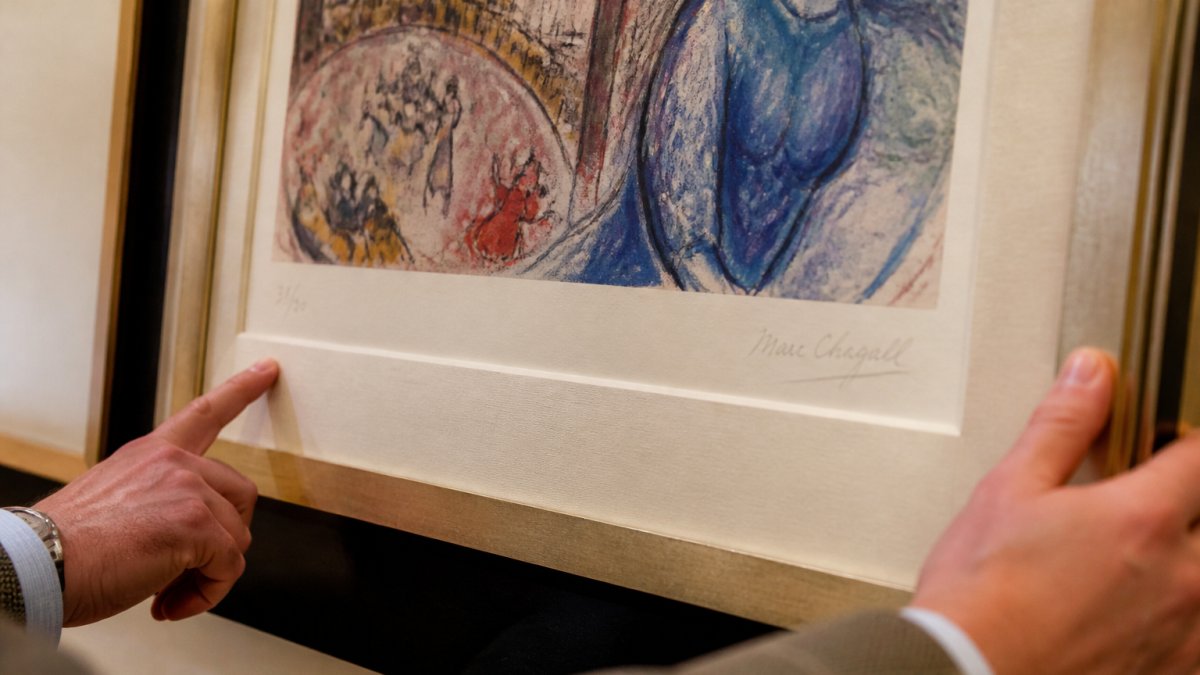
Many Chagall lithographs were issued unsigned and unnumbered in illustrated books and publications such as Derrière le Miroir. A printed signature does not by itself establish that a print is a reproduction, and a pencil signature alone does not prove authenticity. The impression must match the documented edition.
Signature, Edition Numbers, and Documentation
Hand-signed and numbered editions should match their recorded edition details. Other original lithographs were unsigned and unnumbered as issued. Distinguish a hand-applied signature from a signature printed within the image, and describe each accurately.
For lithographs, the six-volume Chagall Lithographe catalogue, associated with Fernand Mourlot and Charles Sorlier, is a key reference. Other media require the appropriate specialist catalogue. A matching catalogue entry helps identify an edition; it does not automatically authenticate every impression bearing that image.
Check any numbering against the documented edition. An added pencil signature or handwritten fraction can be forged, while a printed signature can occur on a genuine original lithograph. Ask the dealer to explain the print's classification and the evidence supporting it.
Paper Quality, Printer's Mark, and Physical Condition
Chagall prints appear on a range of papers, including Arches and other wove papers. Some publication editions use lighter paper. Compare the sheet with the expected paper and dimensions for that edition; weight, texture, or a watermark alone cannot establish authenticity.
Mourlot was an important printer of Chagall's lithographs, and Maeght was a major publisher. Many authentic impressions have no visible printer's stamp or publisher's mark. Where markings exist, compare them with the documented edition rather than treating their presence or absence as proof.
A properly stored vintage lithograph can remain in excellent condition for decades. Foxing, toning, fading, tears, and restoration affect condition and sometimes value; they are not evidence of authenticity.
Marc Chagall Lithographs: The Gold Standard of His Printed Work
Lithography gave Chagall a remarkable range of color and expressive line. His collaborations with master printers, particularly at Mourlot, produced an extensive body of work, from individual editions to illustrated books and gallery publications.
In original lithography, the artist creates an image for printing on a stone, plate, or transfer material, working with a printer to develop the edition. Multiple impressions share the same composition; ordinary printing variations do not make each one a unique artwork.
Stone Lithography vs Offset Lithography
Traditional lithography uses the relationship between grease and water to print from a prepared stone or plate. Edition size is a publishing decision, not simply the result of a stone wearing out. Both the artist's contribution and the documented edition matter.
Commercial offset printing generally reproduces an image through a photomechanical process, transferring ink from a plate via a rubber blanket to paper. An offset reproduction of a Chagall work should be described as a reproduction, even if authorized or issued during his lifetime.
Do not assume that every item called a lithograph is an original Chagall print. Distinguish original lithographs, interpretive lithographs after Chagall, and photomechanical reproductions. A book or journal may contain more than one category.
Notable Lithograph Portfolios and Themes
Chagall's lithographs cluster around recurring themes: lovers in dreamlike landscapes, biblical subjects, village scenes from Vitebsk, musicians, and imaginative figures suspended between earth and sky.
Nice et la Côte d'Azur (1967) celebrates the French Riviera in twelve compositions. Chagall also contributed original lithographs to Derrière le Miroir. Check the particular issue: Maeght describes No. 246 (1981) as containing one original double-page lithograph alongside color and black-and-white reproductions.
Marc Chagall Reproductions: Understanding Authorized Editions
Authorized reproductions reproduce existing artworks with permission from the relevant rights holder. They should be clearly identified as reproductions rather than original Chagall prints. Interpretive lithographs made by another printmaker after Chagall also require precise attribution and edition information.
Authorization concerns permission to reproduce an image; it does not make the result an original print. A counterfeit is an object misrepresented as something it is not. Clear descriptions help collectors distinguish these categories.
Reproductions can offer decorative enjoyment, while unsigned original publication lithographs can provide an accessible way to collect Chagall's original graphic work. There is no universal price dividing originals from reproductions.
Prices vary across all categories. Some historical posters and reproductions have a collecting market, but neither original prints nor reproductions carry a guarantee of appreciation. Choose first for the artwork and assess price against comparable examples of the same edition.
Marc Chagall Print Value: Pricing, Condition, and Market Factors
Marc Chagall print prices vary with the exact work, edition, and condition. The following factors help frame a useful comparison.
Factor |
Impact on Value |
Example |
|---|---|---|
Original vs. Reproduction |
Fundamental distinction |
Compare original lithographs with the same edition, not reproductions of the image. |
Print Type |
Edition-specific |
Original publication lithographs and interpretive prints after Chagall are different categories. |
Edition Size |
One factor among several |
Smaller editions may be scarcer; lower impression numbers do not automatically command a premium. |
Condition |
Often significant |
Fading, foxing, tears, trimming, or restoration can affect price. |
Provenance |
Helpful when available |
Notable history can add interest; a complete chain is not required for every genuine print. |
Signature Status |
Compare like editions |
Signed editions often differ in price from authentic unsigned publication editions. |
Edition Size, Rarity, and Collectibility
A smaller edition may support scarcity, but value also depends on the composition, demand, condition, and actual availability. A lower impression number, such as 1/150 rather than 87/150, does not by itself establish better quality or higher value.
Marc Chagall — Woman at the Window (1968) →
An edition may be small yet attract limited demand, while a more widely issued image may be highly sought after. Compare like-for-like impressions and distinguish dealer asking prices from completed sales.
Lovers, musicians, biblical scenes, and dreamlike landscapes are among Chagall's familiar themes. Collector preferences vary; no subject guarantees a premium or future appreciation.
Provenance, Conservation, and Framing Impact
Provenance is the available ownership history. A notable, documented history can add interest or confidence, but many legitimate Modern Master prints have no complete chain of ownership.
For editioned prints, a correct catalogue reference, matching paper and dimensions, printing characteristics, and informed examination may be more useful than a long provenance. Provide available documentation honestly; incomplete ownership history alone does not make a print suspect.
Conservation framing helps protect paper and color. Use suitable mats, reversible mounting, and glazing appropriate to the work, and avoid direct sunlight. Good framing supports preservation but does not guarantee resale value.
Prints stored in stable temperature and humidity age gracefully. Exposure to heat, humidity fluctuations, or light causes visible deterioration, reducing value.
Available Marc Chagall Prints: Featured Works and Price Range
The Art Howse offers a curated selection of Chagall graphic works, carefully researched and accurately catalogued, with available documentation provided. The examples below illustrate different collecting opportunities; consult the current listings for price, availability, and complete edition details.
Woman at the Window (1968). From the Pierre Matisse Gallery publication, printed by Mourlot, Paris. Consult the listing for the particular impression’s signature status, condition, framing, and current price.

The Dance (1951). An original color lithograph from Derrière le Miroir, unsigned as issued. This illustrates how an original publication lithograph can offer an accessible collecting opportunity.
Vue sur Notre Dame (1981). A reproduction associated with Derrière le Miroir No. 246. It should be distinguished from the original double-page lithograph included in that issue.
Le Couple au Crépuscule (1981). A reproduction from Derrière le Miroir No. 246, offering Chagall's imagery in a different collecting category from his original lithographs.
Fiancés dans le Ciel de Nice (1967). From the Nice et la Côte d'Azur series, representing the more substantial end of the gallery's Chagall selection. Confirm the individual impression's signature, numbering, catalogue reference, and condition against its documentation.
Chagall's graphic work spans a broad range of prices. Unsigned original publication lithographs, signed editions, and accurately described reproductions offer different possibilities. Gallery inventory prices are examples, not universal market thresholds; current availability and pricing may change.
Common Authentication Mistakes and Red Flags
Collecting with confidence means asking useful questions without ruling out beautiful original works because they lack a pencil signature or lengthy ownership history. These are the issues worth checking:
Misdescribed signatures. A printed signature is not a hand signature, but it does not automatically mean reproduction. The description should match the documented edition.
Unsupported claims. Ask what supports the attribution and edition description. A complete ownership history is often unavailable for genuine prints and is not a universal requirement.
Inconsistent edition details. Numbering, dimensions, paper, and publication information should agree with the relevant reference. Handwriting alone is not proof of authenticity.
Overreliance on stamps. Many genuine Chagall prints have no printer's mark. A stamp or certificate also requires evaluation and cannot substitute for examining the work.
Comparisons with the wrong category. A modest price can be appropriate for an unsigned original publication lithograph. Compare the exact edition and condition rather than applying a fixed minimum price.
Maeght’s publication record for Derrière le Miroir No. 246 offers a useful example of an issue containing both an original lithograph and reproductions. Checking the publisher’s description helps distinguish individual images correctly.
At The Art Howse, the first consideration is the artwork itself: its beauty, character, and the connection it creates with the collector. Careful research and clear descriptions then provide the confidence to acquire it. We welcome questions about original Chagall lithographs, publication prints, and the distinctions between editions.
Frequently Asked Questions
How can I tell whether a Marc Chagall print is an original lithograph or a reproduction?
Compare the image, sheet dimensions, paper, printing characteristics, and edition details with the relevant catalogue and publication records. Many original Chagall lithographs were unsigned and unnumbered as issued. A printed signature or missing printer's stamp does not automatically mean reproduction. Ask an experienced dealer to explain the classification and provide available supporting documentation; a certificate alone is not proof.
What affects the value of a Marc Chagall print?
Value depends on the exact composition and edition, collector demand, availability, signature status, and condition. Smaller editions may be scarcer, but lower impression numbers do not by themselves command higher prices. Notable provenance can help when available, though many genuine prints lack a complete ownership history. Conservation framing supports preservation; appreciation is not guaranteed.
How do I find out how much my Marc Chagall print is worth?
Identify the exact image, medium, publication or edition, dimensions, and any signature or numbering. Compare recent completed sales of the same edition, distinguishing auction results from gallery asking prices. An experienced Modern Masters dealer can help assess condition and market context. Obtain an appropriate professional appraisal when needed for insurance or another formal purpose.
What types of prints did Marc Chagall create?
Chagall's original graphic work includes lithographs, etchings, drypoints, and woodcuts, including important illustrated books and publication editions. His lithographs were produced in collaboration with printers such as Mourlot. Reproductions and interpretive prints after Chagall also circulate, and should be distinguished from original prints through precise attribution and edition information.
Where can I buy authentic Marc Chagall prints?
Look for established dealers and galleries with print expertise, clear descriptions, and a willingness to answer questions about edition, condition, and available documentation. Ask how the work has been identified and understand the sale terms. A complete provenance is not available for every genuine print. The Art Howse offers a curated Chagall selection and helps collectors explore works suited to their taste and budget.