

Table of Contents
- Alexander Calder Artwork: A Life in Motion
- Alexander Calder Famous Artworks That Define His Legacy
- Alexander Calder Mobiles: Sculpture That Breathes
- Alexander Calder Stabiles: Monumental Works Rooted to the Earth
- Alexander Calder Prints: Original Lithographs and Works on Paper
- Authenticity, Provenance, and Condition in Calder Artwork
- Seeing Calder Artwork in Person and Building a Collection
- Frequently Asked Questions
Last Updated: October 19, 2026
Alexander Calder Artwork: A Life in Motion
Alexander Calder artwork begins with a simple, radical idea: sculpture does not have to stand still. Born into a family of sculptors, Calder trained as a mechanical engineer before turning to art, and that training shaped everything he made. He bent wire into faces and animals, then set painted metal shapes free to turn in the air. The result changed three-dimensional art permanently.
Calder brought an extraordinary sense of play to modern art. His sculptures are sophisticated feats of engineering, yet their appeal is wonderfully immediate. A mobile can seem almost childlike in its simplicity, until one realizes how carefully its balance, movement, and composition have been conceived. At The Art Howse, that combination of ingenuity and joy draws us to his sculptures and original prints. Below, we explore his career and what to look for when collecting Calder artwork.
Alexander Calder Famous Artworks That Define His Legacy
A Universe (1934). A motorized hanging construction of rods and spheres, now at the Museum of Modern Art, in which the elements move at different rates.
Lobster Trap and Fish Tail (1939). A large hanging mobile at the Museum of Modern Art, made of painted sheet aluminum and steel wire.
Mobile (1941). A standing mobile, also at the Museum of Modern Art, in which a stabile base supports a moving upper assembly.
La Grande Vitesse (1969). A monumental stabile in Grand Rapids, Michigan, and one of the first large-scale public commissions of its kind in the United States.
Flamingo (1973). A 53-foot stabile in Chicago's Federal Plaza, made of painted steel.
Derrière le Miroir #212 (1975). A portfolio of lithographs published by Galerie Maeght, including Card Players, Craps Player, Poker Players, and Untitled (Plate 7).

Read together, these objects trace a clear arc: from hand-held performance, to motorized experiment, to air-driven mobile, to architectural stabile, to the flat, buoyant color of the late prints.
Alexander Calder Mobiles: Sculpture That Breathes
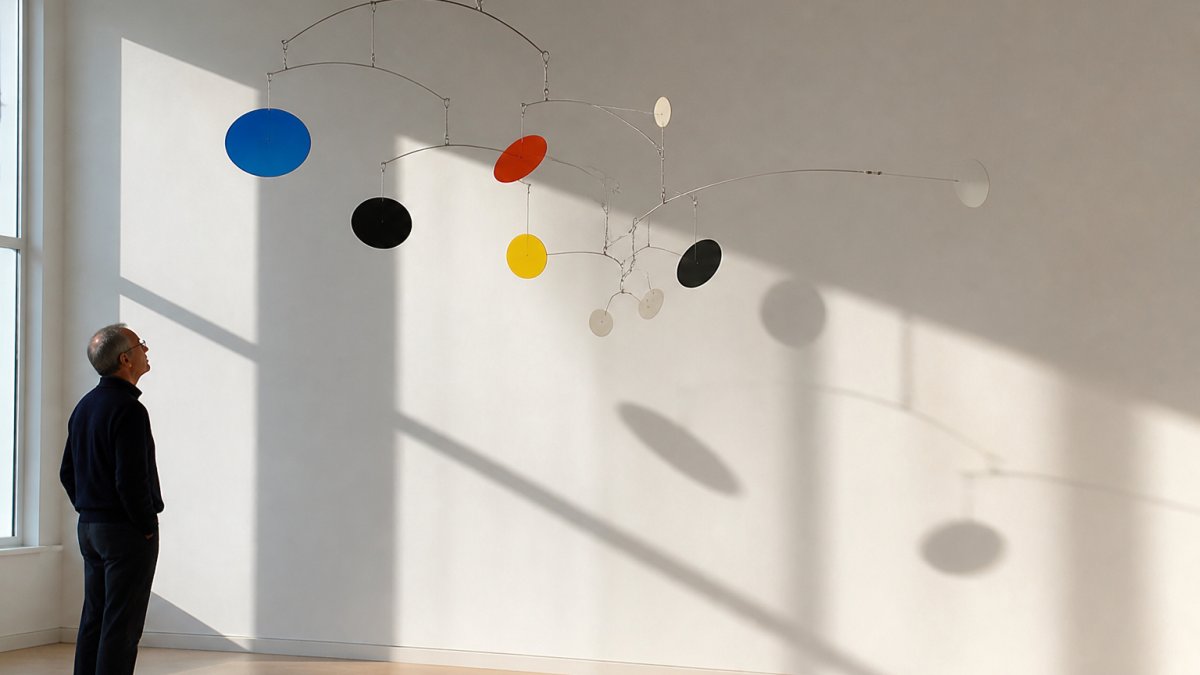
A Calder mobile is a hanging sculpture of balanced metal elements that move with air currents, and it is the form most people picture when they hear his name. Marcel Duchamp reportedly suggested the name "mobile" for these works, playing on the French word for motive and motion alike. But "mobile" is a broad label, and the objects it covers behave in quite different ways.
A Visual Taxonomy: Mobiles, Standing Mobiles, and Stabiles
A useful way to look at Calder's sculpture is to sort it by what moves and what stands still.
- Hanging mobile. The whole assembly hangs from a single point, usually the ceiling, and every element is free to turn. Lobster Trap and Fish Tail (1939) is a classic example.
- Standing mobile. A stabile base supports a moving upper assembly, so part of the piece is rooted and part is free. Mobile (1941) at the Museum of Modern Art is a clear example.
- Stabile. The sculpture is stationary throughout. The term is generally credited to Jean Arp, who punned on "mobile" by adding the prefix for standing. Flamingo (1973) is a monumental example.
- Wall-mounted and table-top works. Smaller pieces that hang from a bracket or rest on a base, often made for domestic spaces rather than civic ones.
The taxonomy matters because it changes how you look. A hanging mobile asks you to watch the whole silhouette shift; a standing mobile asks you to compare the fixed base with the moving top; a stabile asks you to walk around it and read the changing outline against the sky.
How Balance, Weighting, and Suspension Actually Work
Balance is the engineering heart of a Calder mobile. Each arm is a lever, and each element is weighted so the whole assembly finds equilibrium. A well-made mobile settles into a slow, continuous drift rather than tipping, because the counterweights on each arm are matched to the elements they carry.
The suspension is equally deliberate. Wires are thin enough to nearly disappear, so the eye reads the painted shapes as floating rather than hanging. The joints are designed to allow rotation without binding, which is why a good mobile keeps moving long after the air that started it has stilled.
Calder's engineering education gave him an instinct for load distribution that most sculptors of his generation simply did not have. A common mistake among viewers is assuming the pieces are random. They are not. Every arm length and every counterweight is calculated so the sculpture can move freely without ever losing its poise.
A Close Reading: Lobster Trap and Fish Tail
Look closely at Lobster Trap and Fish Tail and the mechanics become visible. A long horizontal arm carries a cluster of smaller elements on one side and a larger, heavier form on the other, so the piece balances across an asymmetric load. The red and blue plates are placed to make the eye travel along the arm as it turns, and the open wire framework lets the wall or sky show through the sculpture rather than blocking it.
That is the lesson of a Calder mobile: the composition is never fixed. What you see in the first minute is only one of many arrangements the piece will present, and the sculpture is designed to keep offering new ones.
Alexander Calder Stabiles: Monumental Works Rooted to the Earth
Stabiles are Calder's stationary sculptures, and the term is generally credited to Jean Arp, who punned on "mobile" by adding the prefix for standing. Where a mobile breathes, a stabile plants itself.
These works took Calder's vocabulary of curved plates and tapering legs to civic scale. Public art commissions made him a household name in cities across the country, and his large stabiles remain landmarks wherever they stand. The forms read differently outdoors: sky becomes part of the composition, and the sculpture's silhouette shifts with the sun.
Alexander Calder Prints: Original Lithographs and Works on Paper
Most people first encounter Calder through his mobiles. His original lithographs carry the same visual language onto paper: bold color, confident lines, playful shapes, and a remarkable sense of balance. The forms stay still, yet the eye keeps moving between them. For collectors drawn to that energy, a lithograph offers a distinctive way to live with Calder’s art.
His collaboration with Galerie Maeght placed original lithographs within reach of a wider audience through Derrière le Miroir. These works deserve to be considered on their own terms: as compositions conceived for print, with their own scale, texture, and presence.
Derrière le Miroir #212: A Portfolio Worth Knowing
Derrière le Miroir was a publication of Galerie Maeght in Paris, and issue #212 from 1975 is devoted to Calder. The portfolio includes lithographs such as Card Players, Craps Player, Poker Players, and Untitled (Plate 7), all unnumbered and unsigned, in the 15 × 11 inch and 15 × 22 inch formats.

Unsigned and unnumbered does not mean inauthentic. The regular publication edition differs from the separately issued deluxe edition. Many legitimate original lithographs published in art journals carry no pencil signature or edition number. Maeght’s record for issue #212 lists original lithographs alongside reproductions, making identification of the particular image and printing process essential. What matters is evidence appropriate to the specific work and edition.
Work |
Format |
Medium |
Notes |
|---|---|---|---|
Card Players |
15 × 11 in |
Lithograph in colors |
Playful card-game scene |
Craps Player (Plate 4) |
15 × 11 in |
Lithograph in colors |
Intimate scale |
Poker Players (Plate 5) |
15 × 22 in |
Lithograph |
Large-format statement |
Untitled (Plate 7) |
15 × 22 in |
Lithograph |
Biomorphic shapes |
Authenticity, Provenance, and Condition in Calder Artwork
Authenticity, provenance, and condition are three separate questions, and conflating them causes most collecting mistakes. Authenticity asks whether the work is what it claims to be. Provenance is the known ownership history. Condition describes the physical state of the object.
Many legitimate original prints lack a complete ownership chain or a prior owner's invoice. That absence is not automatically a red flag. Signatures and numbering alone do not prove authenticity either, and legitimate editions can be unsigned or unnumbered. Evidence appropriate to the artist, medium, and edition is the standard to apply. The Calder Foundation's catalogue raisonné and research resources are the reference point for verifying works.
For sculpture, condition questions center on paint, wire integrity, and any restoration. Discuss these calmly and proportionately. A conservator's assessment is useful when a specific concern arises.
Seeing Calder Artwork in Person and Building a Collection
Seeing Calder artwork in person changes how you understand it. Museum collections hold major mobiles and stabiles, and gallery exhibitions regularly bring works on paper into view. Watch a mobile for several minutes, walk around a stabile, and look closely at a lithograph's paper and ink.
Building a collection starts with your own eye. Decide whether you respond to the movement of a mobile, the permanence of a stabile, or the immediacy of a print. Then match the evidence to the medium: publication details for prints, exhibition and ownership records where they exist, and a clear account of condition.
The Museum of Modern Art's Calder collection offers an excellent starting point for studying his range, and the National Gallery of Art's collection records provides further reference for works on paper and sculpture.
We keep a small, carefully chosen group of Calder lithographs from the Derrière le Miroir #212 portfolio, each with its publication details clearly stated. Browse the collection and see which one speaks to you.
Frequently Asked Questions
What is the difference between a Calder mobile and a stabile?
Calder developed both moving and stationary abstract sculptures. Marcel Duchamp coined the term “mobile” in 1931; Jean Arp subsequently dubbed the stationary works “stabiles.” Hanging mobiles respond to air currents, while standing mobiles combine a fixed base with moving elements. Stabiles remain stationary, inviting viewers to walk around them and discover changing silhouettes.
How can I tell whether an Alexander Calder print is an original or a reproduction?
Begin with the specific work’s publication and edition details. Compare its image, paper, sheet size, printing process, and any folds or text with reliable references for that edition. Derrière le Miroir #212 includes both original lithographs and reproductions, so the issue number alone does not establish originality. Reproductions can carry publisher credits, and a dot pattern under magnification is not a conclusive test on its own. Signatures and numbering are also insufficient: legitimate original prints can be unsigned and unnumbered. Ask the seller to identify the publisher, date, medium, and supporting references.
What should I look for when evaluating an Alexander Calder print?
Check the sheet size against the documented edition, confirm the publisher and date, and examine the margins for trimming. Look at the colors under even light and note any fading, foxing, or handling creases. Ask whether the work is framed with archival materials. Condition matters, but a clean, well-documented impression counts for more than a perfect sheet with no history. If a detail cannot be verified, ask the seller to qualify it rather than assume.
Where can I see Alexander Calder artwork in person?
Major museum collections across the United States hold Calder works, and public commissions stand in plazas and cultural campuses in several cities. Temporary gallery exhibitions are worth watching, since they often bring together mobiles, stabiles, and works on paper in one place. Seeing a mobile move in person tells you more about scale and balance than any photograph. If you are considering an acquisition, viewing comparable works in a museum first gives you a useful benchmark for condition and presence.
Alexander Calder reminds us that great art need not be solemn to be profound. His work combines imagination, technical ingenuity, and an unmistakable sense of joy. For collectors drawn to his visual language, original lithographs offer an engaging way to bring that spirit into their homes.
At The Art Howse, we invite you to explore our selection of original Calder lithographs published by Galerie Maeght.