

Table of Contents
- Start With Taste: The Collector's Foundation
- How to Invest in Art: A Step-by-Step Approach
- Art Market Research: Reading Artists, Prices, and Demand
- Fine Art Portfolio Diversification: Balancing the Collection
- Art Provenance and Authenticity: What to Verify Before You Buy
- The Costs That Shape Your Net Return
- Common Mistakes Collectors Make
- Frequently Asked Questions
Last Updated: October 21, 2026
Start With Taste: The Collector's Foundation
An art investment portfolio is a considered group of artworks acquired with both visual pleasure and long-term value in mind, built around what you actually want to live with. Every conversation about how to build an art investment portfolio starts with looking, not spreadsheets.
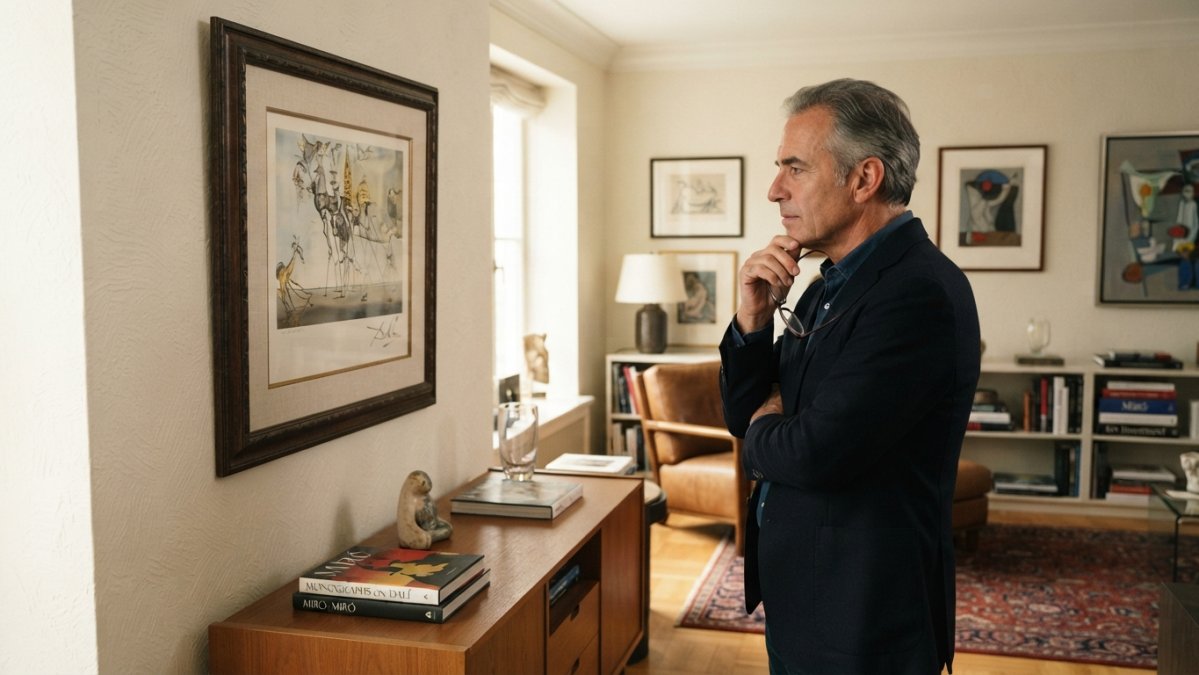
Why the Best Portfolios Begin With Looking
Taste is not a soft preliminary to investing; it is the filter that keeps a collection coherent. A collector who can articulate why a picture matters makes sharper decisions about edition, condition, and price.
How to Invest in Art: A Step-by-Step Approach
Learning how to invest in art starts with two decisions unrelated to any individual picture: how long you can leave money committed, and what you can comfortably afford to have tied up.
Step 1: Define Your Investment Horizon and Risk Tolerance
Your investment horizon is the number of years you can hold a work without needing to sell it. Art trades privately and at auction, and selling takes time, so a short horizon creates pressure that leads to poor decisions. Risk tolerance works the same way: if a decline in value would keep you awake, size the position accordingly.
Assess each artwork on its own merits. The artist, subject, period, edition, condition, provenance, purchase price, and depth of buyer demand all affect its market. A rare print may take longer to sell than a unique painting; a signature or catalog reference does not establish liquidity. Buy within a budget that allows you to hold the work without relying on a quick resale.
Step 2: Set a Budget That Includes the Full Cost of Ownership
A budget covering only the purchase price is incomplete. Framing, shipping, insurance, and any conservation work all belong in the number. Decide what share of your total outlay goes to the artwork itself, and hold the rest back.
Art Market Research: Reading Artists, Prices, and Demand
Art market research means building a picture of an artist's standing from several kinds of evidence rather than a single headline number. Auction results are the most visible data, but only part of the story.
Auction Results and the Invisible Market
Auction records show public prices for works that came to sale, useful for context but not as a valuation for the specific piece in front of you.
Scholarship and close looking sit at the center of informed buying. For catalog and edition details on a specific print, consult the relevant catalogue raisonné alongside publisher and printer records and advice from a specialist familiar with the artist.
Fine Art Portfolio Diversification: Balancing the Collection
Fine art portfolio diversification means spreading your commitment across artists, periods, media, and price levels so no single decision carries the whole collection. In art, the assets are not interchangeable units: two lithographs by the same artist from the same decade can behave very differently depending on edition size, condition, and subject, so diversification must be understood at the level of the individual work, not just the name on the wall.
What Diversification Actually Does in a Collection
Diversification does not remove risk from an art collection; it changes the shape of the risk. A collection concentrated in one artist rises and falls with that artist's market, while one spread across several artists, periods, and media smooths the ride.
The mechanisms worth understanding:
- Artist concentration. Several works by one artist feel like a collection but behave like a single position. If that artist's market cools, the whole collection cools with it.
- Period and movement concentration. Works from a single movement, say, mid-century Surrealist prints, tend to share buyers, galleries, and auction calendars, so they can move together.
- Medium concentration. Works on paper, canvases, and sculpture have different buyer pools, different handling requirements, and different resale rhythms. A collection of works on paper only is exposed to whatever is happening in that segment.
A Framework for Thinking About Balance
Build around complementary works, periods, and artistic interests rather than fixed percentages. An established master might sit alongside a contemporary painting because each adds something meaningful to the collection. Give equal attention to the quality of each work, the evidence behind it, and the pleasure it brings.
Ask whether the collection has a sense of direction and whether each acquisition deepens your understanding or introduces a fresh perspective. There is no standard allocation that makes a collection right for everyone.
Collectors drawn to Modern Masters can explore different artists, periods, and printmaking traditions while maintaining a coherent collection. Contemporary work can bring another perspective. Neither category guarantees appreciation or an easy resale.
Applying the Framework in Practice
A few habits make the framework usable:
- Write down what you own and why. A simple list of each work, the artist, the medium, the edition, and the reason you bought it reveals concentration faster than memory does.
-
Look for accidental overlap. Two works by different artists from the same movement, bought from the same dealer in the same year, may be less diversified than they appear.
Keep room for the right opportunity. Leave part of your collecting budget available so an unexpected work can be considered without a rushed sale or an uncomfortable financial commitment.
- Revisit the balance after each acquisition. Diversification is a running description of a collection, not a one-time decision.
Where Diversification Meets Taste
The tension between diversification and taste is real, and need not be resolved in favor of either. A collector with a deep attachment to one artist may reasonably choose concentration, provided they understand what they are choosing; a collector building broadly may reasonably accept that no single work is the centerpiece. What matters is that the choice is deliberate.
Art Provenance and Authenticity: What to Verify Before You Buy
Art provenance and authenticity are related but distinct questions. Provenance is the known history of ownership; authenticity is whether the work is what it claims to be. A complete ownership chain is helpful evidence, but plenty of legitimate original prints have gaps, and many were never exhibited or invoiced in ways that survive.
What counts as good evidence depends on the artist, the medium, and the edition:
- Catalog references: inclusion in the artist's catalogue raisonné, with the plate or entry number
- Signatures and numbering: useful, but not proof on their own, and legitimate editions exist unsigned and unnumbered
- Publisher and printer records: documentation of who produced the edition and when
A Certificate of Authenticity is a dealer's statement, not a government registration, and its weight depends entirely on who issued it. Ask what the certificate is based on.
Salvador Dali-Symphony Bicyclette →
The Costs That Shape Your Net Return
Return on investment in art is calculated after costs, not before. Purchase price is the beginning of the arithmetic, and the gap between what a work costs to acquire and what it returns when sold is where most practical thinking belongs.
The Cost Categories, in the Order They Arrive
At acquisition:
- The purchase price itself, including any buyer's premium if you are buying at auction. The premium is charged on top of the hammer price and is part of your cost basis.
- Shipping and transit insurance, which vary with size, fragility, and distance.
- Framing, if the work is not already framed to your satisfaction. Framing is often a meaningful fraction of the cost of a modestly priced work, and it is rarely recoverable on resale.
While you own it:
- Insurance, whether through a rider on a homeowner's policy or a standalone fine-art policy. Premiums depend on the value insured and the storage conditions.
- Conservation, when needed. Works on paper are sensitive to light, humidity, and handling; a framed print on a wall in direct sun will fade. Conservation is not mandatory for every work, but the risk of needing it belongs in the model.
- Storage, if the collection outgrows the wall. Climate-controlled storage is a real cost for collectors who rotate works or hold pieces they cannot display.
At sale:
- Auction commissions and fees, which are charged to the seller and vary by house, value, and negotiation. These can take a meaningful share of the gross result.
- Shipping and insurance to the buyer, often borne by the seller depending on the terms.
- Any negotiated dealer commission, which should be agreed in writing before the sale.
Building a Simple Net-Return Model
A spreadsheet helps. The model has four lines:
- Total acquisition cost = purchase price + premium + shipping + framing + tax.
- Total carrying cost = insurance + conservation + storage, summed over the holding period.
- Gross sale proceeds = the price at which the work sells.
- Net proceeds = gross proceeds − sale commissions − sale-side shipping and insurance.
Your net result is net proceeds minus total acquisition cost minus total carrying cost. The point is not precision; it is to make visible how much of a gross gain is consumed by costs before any of it reaches you.
What the Model Changes About How You Buy
Once you have run the arithmetic a few times, three habits follow:
- You buy works you can hold. Costs accumulate over time, and a short holding period gives them less time to be absorbed. The model rewards patience.
- You pay attention to framing and condition at the point of purchase. A work that arrives needing conservation and reframing carries costs the purchase price did not show.
-
You ask about sale terms before you buy. Knowing how a dealer or auction house charges on the sell side is part of understanding the total economics of an acquisition.
Over more than twenty-five years working with collectors, I've found that the most satisfying collections rarely begin with a financial strategy. They begin with a connection to an artist or a particular work. Understanding the market matters, of course, but the pleasure of ownership should never become secondary to the possibility of appreciation.
Ask any dealer directly: what will this cost in total, and what will selling it later involve? A straight answer is a reasonable thing to expect.
The Costs You Cannot Model
The model covers costs you can anticipate, but circumstances can change: a quiet market when you want to sell, a change in your own needs, or unforeseen conservation. Keeping a financial cushion and buying works you can comfortably hold helps you make considered decisions.
Common Mistakes Collectors Make
The most expensive mistakes in collecting are rarely about picking the wrong artist. They are about process.
- Buying the story instead of the object. A compelling narrative cannot substitute for looking closely at condition, margins, and impression quality.
- Treating a signature as proof. Signatures and numbering support authenticity; they do not establish it alone.
- Overlooking total cost. Framing and insurance are part of the investment, not an afterthought.
- Concentrating in one artist. Conviction is fine; a collection that rises and falls on a single name is a bet, not a portfolio.
- Buying what you cannot hold. If a work might need to be sold within a year or two, the timing will decide the price, not you.
Our Salvador Dalí Symphony Bicyclette offers a starting point for exploring how a work’s artistic story and supporting documentation inform a collecting decision. Review the individual listing and discuss the edition, condition, and accompanying documentation before acquiring any print.

Building a collection that satisfies both your eye and your long-term thinking takes patience, honest information, and a dealer willing to talk through the evidence rather than around it. The Art Howse works with collectors on works by the Modern Masters and select established contemporary artists, from signed Dalí editions to original watercolors with archived provenance.
Frequently Asked Questions
How do you create a portfolio of art?
Begin with a clear sense of what you genuinely enjoy looking at, then set a budget that accounts for framing, insurance, and storage alongside the purchase price. Research the artists you are drawn to, review auction results, and verify provenance and authenticity before committing. Build gradually across artists, periods, and media so that no single work carries the whole collection. An art investment portfolio should reflect your taste first and your financial goals second.
Can fine art be both a personal passion and a long-term investment?
Yes. Enjoyment and thoughtful attention to long-term value can coexist. Begin with an artwork you want to live with, then examine its quality, condition, documentation, price, and market. Appreciation is uncertain, and selling can take time and involve substantial costs. The pleasure of ownership should remain worthwhile even if the work never increases in value.
What should you consider before adding an artwork to a collection?
Ask whether the work fits your collection's direction, whether the price is fair relative to comparable sales, and whether the condition is sound. Confirm what documentation accompanies it: a Certificate of Authenticity, any known ownership history, and the edition details for prints. Factor in framing, insurance, and storage costs. Finally, consider how the piece affects your fine art portfolio diversification rather than duplicating what you already own.
How can you research an artist's market and exhibition history?
Start with auction records for comparable works, noting medium, size, edition, and sale date rather than headline prices alone. Museum exhibitions, gallery representation, and catalogue raisonné inclusion all signal an artist's standing. Art market research also means watching how demand shifts over several years, not one season. Speak with dealers who handle the artist, and treat any single data point as one piece of a larger picture.
What is the difference between an original print and a reproduction?
An original print is an artwork conceived and executed as a print through an authorized artistic process, often in collaboration with skilled printers and workshops. The artist need not personally perform every stage of making or printing the matrix. A reproduction copies an existing artwork rather than constituting an original work in the print medium. Signatures and numbering alone do not establish the distinction; the technique, publisher, edition history, and relevant catalogue raisonné references all matter. Legitimate original prints can be unsigned or unnumbered.
How do provenance and a Certificate of Authenticity differ?
Provenance is the documented history of who has owned a work and where it has been shown or sold. A Certificate of Authenticity is a statement, usually from the artist, publisher, or a recognized authority, confirming the work's identity. The two are related but distinct: a certificate supports authenticity, while provenance traces ownership. Many legitimate original prints lack a complete ownership chain, so weigh the evidence appropriate to the artist, medium, and edition.
How should collectors think about diversification in an art portfolio?
Build around complementary artists, periods, media, and interests rather than fixed percentages. Consider what each work adds to the collection and assess its quality, condition, documentation, price, and buyer demand individually. An established name, a limited edition, or a particular medium does not guarantee stability or liquidity. A focused collection can also be rewarding when its concentration is deliberate and comfortably affordable.
How can you assess an artwork's condition before buying?
Ask for a condition report and, where appropriate, detailed photographs of the surface, edges, and frame. For works on paper, check for foxing, tears, fading, and whether the sheet has been trimmed. For paintings, look at the stability of the paint layer and any prior restoration. Framing and storage conditions matter too. Condition affects both enjoyment and resale value, so raise questions before you commit rather than after.